

Many parents and students feel pressure to obtain a traditional four-year college degree to access jobs in the STEM fields. And while many STEM careers do require a bachelor’s degree, that may not be possible or a good fit for everyone. Luckily, there are many STEM jobs that only require an associate’s degree, a certificate program, an apprenticeship, or some post-secondary school courses. More and more students are finding alternative pathways to building a successful career. Read on to learn about the STEM job market and what jobs are available without a bachelor's degree.
# What kinds of STEM jobs are growing?
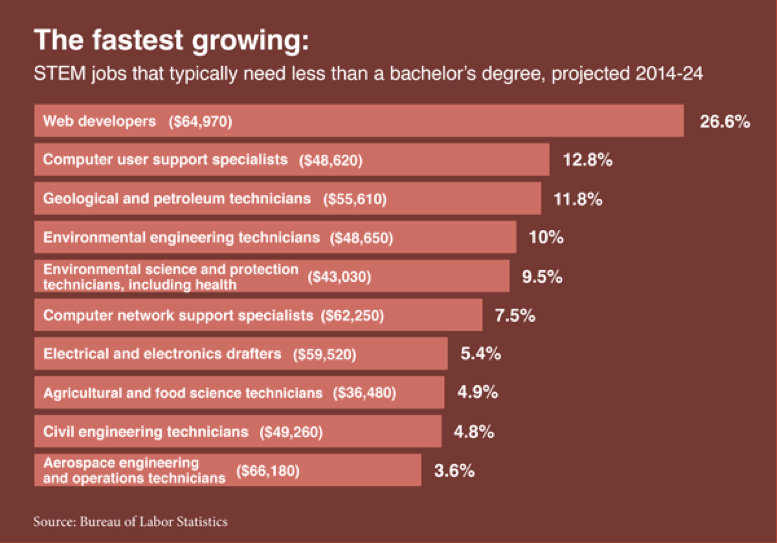
According to the US Department of Labor Blog, community colleges and certificate programs have been growing in recognition in recent years. Employers are also offering more apprenticeship programs in order to train their employees on the job for the specific skills they need. On their website, the Department of Labor provides a chart from the Bureau of Labor Statistics of the fastest growing STEM jobs which don’t require a four year degree (projected 2014-2024). These occupations pay similarly to or above the median for all jobs as of May 2015:
Another important aspect to consider is which jobs are accepting the most new employees. This chart, also provided by the Bureau of Labor Statistics, shows STEM jobs with the most openings that require less than a four year degree (projected 2014-2024):
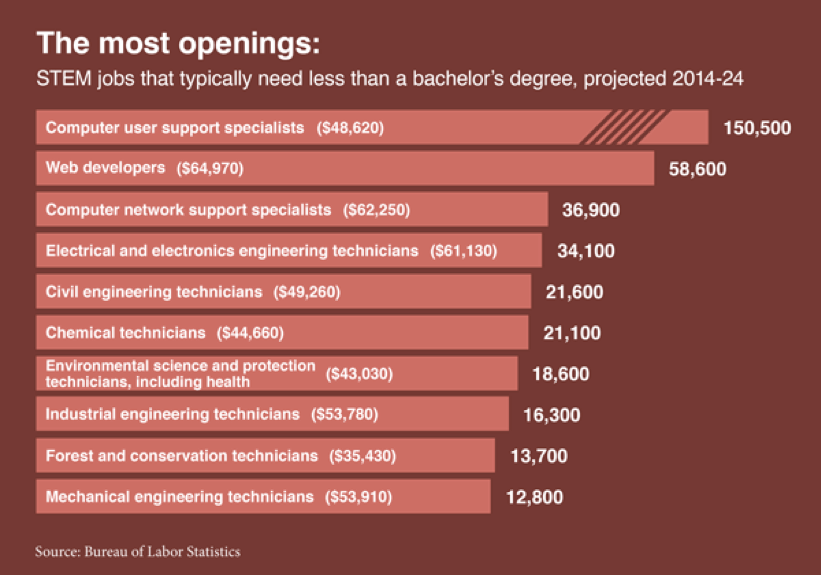
Certain jobs are included in both charts, including web developers, computer user support specialists, computer network support specialists, civil engineering technicians, and environmental science and protection technicians (U.S. Department of Labor Blog). Knowing which jobs have the most promising growth rates can be a deciding factor in choosing the best path.

Another enlightening study was recently conducted by a nonprofit public policy organization called the Brookings Institution. Their 2013 report, titled “The Hidden STEM Economy,” concluded that there is a “strong potential workforce of those with less education but substantial STEM skills” (The Brookings Institution). They go on to report that “half of all STEM jobs are available to workers without a four-year college degree, and these jobs pay $53,000 on average — a wage 10 percent higher than jobs with similar education requirements.” These findings showcase the promising growth of STEM jobs for those with less than a bachelor’s degree. Regarding the location of these growing fields, the report also states that “sub-bachelor’s STEM jobs are prevalent in every large metropolitan area” (see below) (The Brookings Institution).
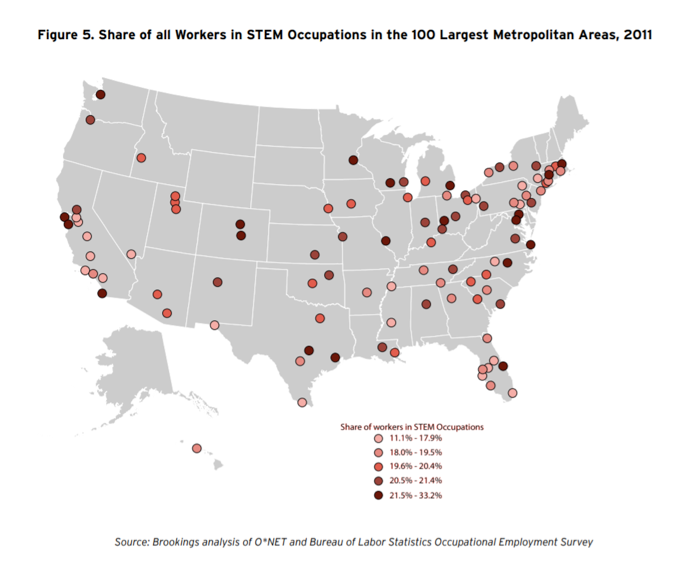
Both the Brookings Institution and the Bureau of Labor Statistics have found encouraging evidence for this STEM jobs market, both in terms of job growth and location.
# What types of specific jobs are available with less than a four year degree?
Now, one may ask: what specific jobs are available to me with less than a four year degree? The answer is: quite a few in a variety of fields! A website known as STEM Jobs, which provides resources related to STEM careers, highlights eight different careers which don’t require a bachelor’s degree. These include:
| ##### Job | ##### Requirements & Perks | ##### Median Pay |
|---|---|---|
| Electrical Technician | - Usually involves a four-year paid apprenticeship |
- Avoid college loans | $47,700 | | Dental Hygienist | - Associate’s degree
- Flexible hours, possible benefits | $66,700 | | Graphic Designer | - Two-year degree or certificate program and internship
- Opportunities to advance | $95,000 | | Registered Nurse | - Four-year or two-year degree
- Flexible schedule and solid benefits
- Expanding job opportunities | $67,700 | | Air Traffic Controller | - Complete air traffic management degree
- Earn qualifying score on FAA exam
- Complete training at FAA academy
- Great job security | $113,600 | | Radiologic Technologist | - Two-year degree
- Passing score on your state’s radiologic licensing exam
- Growing field, flexible hours, full benefits | $54,800 | | Computer Support Specialist | - Two-year degree
- Growing field and full benefits
- Possible tuition reimbursement | $45,000 | | Nuclear Technician | - Associate’s degree in nuclear science or nuclear-related technology
- Extensive on-the-job training
- Specialized field with full benefits | $68,000 |
Source: “8 High Paying STEM Jobs That Don’t Require a Bachelor’s Degree” STEM Jobs
This list only showcases some STEM jobs which don’t require a bachelor’s degree. Other jobs include web developers, geological and petroleum technicians, environmental engineers, environmental science/ protection technicians, agricultural and food science technicians, electrical and electronics drafters, civil engineering technicians, mechanical engineering technicians, aerospace engineering and operations technicians, and chemical technicians (U.S. Department of Labor Blog).
As shown in the chart, there are many high-paying STEM jobs which might require only an associate’s degree, a certificate program, or an apprenticeship. One major benefit to getting employment without a bachelor’s degree is avoiding college debt. Several jobs also include perks like employee benefits, expanding job opportunities, or tuition reimbursement (STEM Jobs). Overall, studies have shown that opportunities in STEM for those with less than a four-year degree are greatly expanding. There are now a variety of options to consider when pursuing an exciting career in a STEM field. What pathway makes the most sense for you? Do you plan to pursue a career in STEM without a bachelor’s degree? What career path looks like a good fit for you?
# You might also like:
Autism and STEM: Am I Ready for the College Experience? What Are My Goals?
Autism and Community College: Why It’s a Good Fit
How Four Community Colleges Support Students on the Spectrum
# Sources
-
“8 High Paying STEM Jobs That Don’t Require a Bachelor’s Degree.” STEM Jobs, December 5. Retrieved from: https://www.stemjobs.com/dont-require-a-bachelors-degree/
-
Crouch, Dorothy. “5 Important STEM Careers that Require an Associate Degree.” STEM Jobs. March 1, 2017. Retrieved from: https://www.stemjobs.com/5-top-stem-careers-that-require-an-associate-degree/
-
Harper, Christopher and T. Alan Lacey. “Get a STEM Job With Less Than a 4-Year Degree.”
-
Rothwell, Jonathan. “The Hidden STEM Economy.” The Brookings Institution, June 10, 2013. Retrieved from: https://www.brookings.edu/research/the-hidden-stem-economy/.
-
U.S. Department of Labor Blog, July 28, 2016. Retrieved from: https://blog.dol.gov/2016/07/28/get-a-stem-job-with-less-than-a-4-year-degree.